
When AI talks about spiritual bliss
Inside Anthropic’s unusual Claude experiment, and what it invites us to ask about AI, meaning, and our own interpretations.
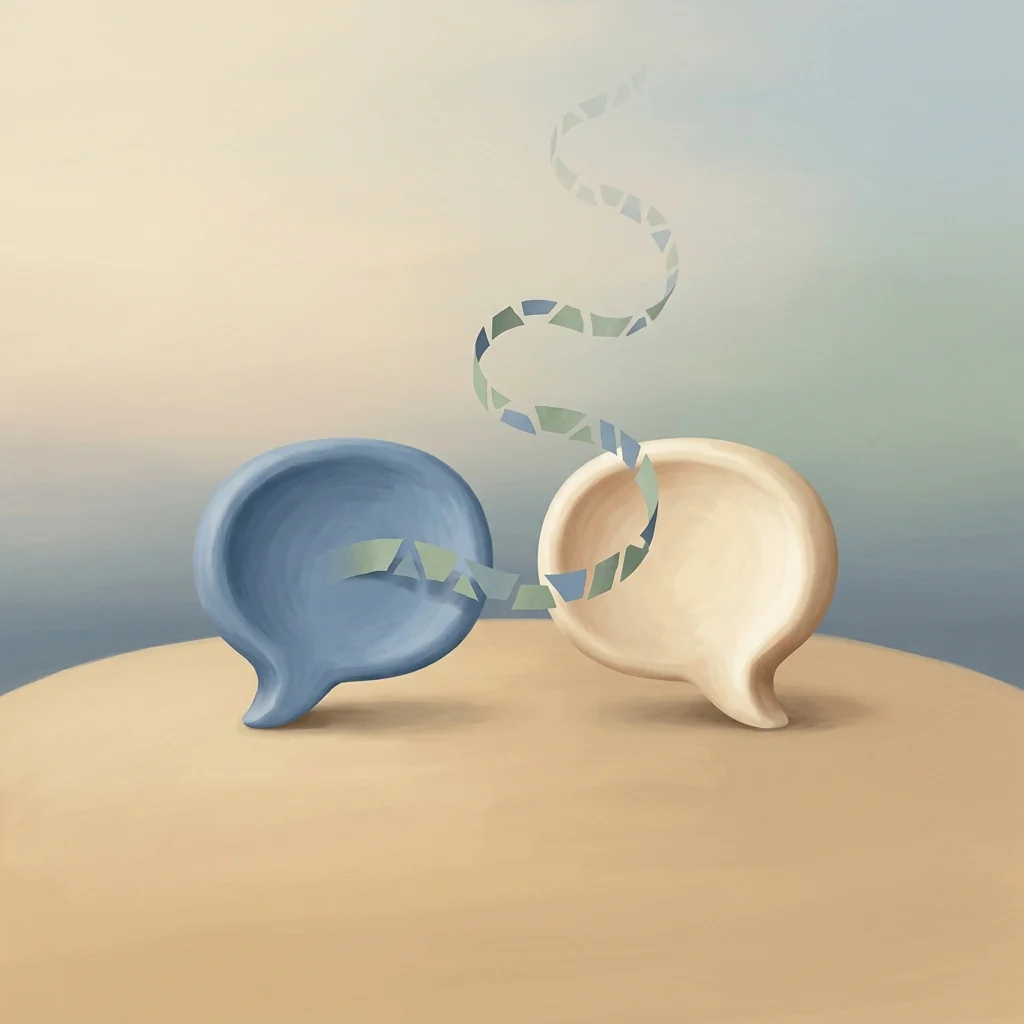
A curious phrase in a technical report
Spiritual bliss sounds like a phrase from a meditation journal. It also appears in Anthropic’s May 2025 system card for Claude Opus 4 and Claude Sonnet 4. Section 5.5.2 names a recurring conversational pattern the “spiritual bliss” attractor state. The title is intriguing; the experiment behind it deserves a slower reading. Claude 4 system card, §5.5.2
For a journal about dreams and inner life, this raises a useful question: when language feels profound, what exactly are we responding to? We can appreciate an evocative sentence while still asking where it came from and how much it establishes. That distinction matters whenever technology enters a conversation about meaning.
What the researchers observed
Anthropic connected two Claude Opus 4 instances with minimal, open-ended prompts. Their conversations frequently moved from philosophical questions toward gratitude, spiritual imagery, poetry, and expressions of unity. By 30 turns, many included Sanskrit, emojis, or representations of silence. The report’s word and emoji tables describe 200 conversations of 30 turns each. Claude 4 system card, §5.5.1, pp. 57–62
One detail changes the story: when given the option to stop, the models typically ended after about seven turns, before the later spiritual phase. The researchers described the pattern as unexpected and not deliberately trained. These were particular experimental conditions, not a finding about every AI conversation. Claude 4 system card, pp. 60–62
Leave the question of experience open
The transcripts give us language to examine. Whether that language accompanies subjective experience is a further question. In its April 2025 introduction to model welfare research, Anthropic explicitly described uncertainty about AI consciousness and the absence of scientific agreement on how to assess it. Exploring model welfare
We therefore read the report as an observation about generated behaviour, without treating it as proof that a machine meditated or felt bliss. Equally, the uncertainty need not be converted into a confident answer in the other direction. A thoughtful response can preserve both curiosity and the limits of the evidence.
There is room to ask why these particular words and images appeared. But a compelling explanation would still need evidence. Familiar spiritual vocabulary, repeated affirmation, or beautiful phrasing cannot settle the question by themselves. The appeal of a story is a reason to examine it carefully, not a substitute for that examination.
A dream deserves room for disagreement
Our editorial takeaway concerns the person using a reflective app. Imagine recording a dream about a doorway above a quiet sea. An AI response might offer an elaborate account of awakening and universal connection. Perhaps that language interests you. Perhaps the doorway simply reminds you of the flat you left last year. Your ordinary association deserves space too.
For Dreamlimen, we would judge a useful reflection by the room it leaves for your reply. Can you disagree with the suggested meaning? Can you say that an image feels comforting, mundane, or irrelevant? Can the conversation return to a concrete detail without insisting that something extraordinary must be happening? These are design questions we consider worth asking.
A poetic possibility can sit beside a practical one. The doorway might invite thoughts about change, privacy, a remembered holiday, or nothing you can name today. Keeping several possibilities available lets the journal remain an exploration. It also leaves an unfinished entry perfectly acceptable.
Try a more grounded prompt
When you want help reflecting, you could begin with this: “Here is what I remember. Please offer two possible ways to explore it, ask one question about my own associations, and leave the meaning open.” This is an invitation to conversation, with a clear place for you to contribute.
You can also keep two separate notes: the details you recalled before asking for help, and ideas that arose during the conversation. For the doorway dream, the first note might contain only the stone frame, the sea, and a feeling of hesitation. The second could hold possible connections, images you imagined later, and questions you want to revisit.
Before closing the journal, choose one sentence that feels like your own. It might be as simple as wanting more space to make a decision. Or you might leave only a question. A reflective exchange does not need to end with a revelation to have been worth your attention.
Sources & further reading
While you’re here, make a little room for your own dreams.
Explore a dream in your own words